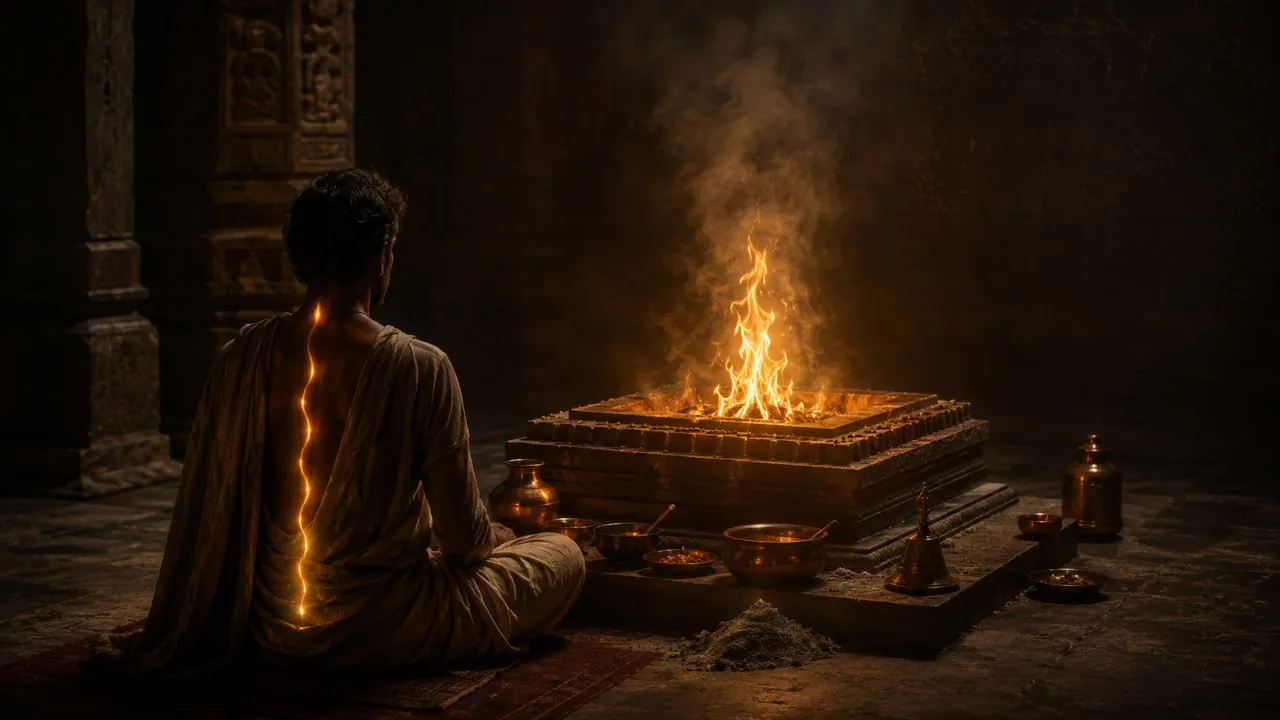
Yagya is one of the ancient paths of spiritual practice, along with yoga, meditation and tantra. Its deep meaning is not limited to the fulfillment of desires or the realization of intentions. The basis of yagya is turning to the Highest, purifying a person and gradually approaching knowledge and a state of consciousness that is higher than the ordinary mind.
Each spiritual path has its own language. Yoga guides a person through body, breath, discipline and action. Meditation teaches you to see the movement of the mind, calm the inner noise and return to silence. Tantra, in its true sense, reveals the connection between the power of life, consciousness and the Divine. Yagya leads through fire, mantra, offering and prayerful presence.
This is her special place. Yagya teaches a person to come to the Supreme not only with a request, but also with a purified intention. In it, not only the practice itself is important, but also the internal state: with what heart a person approaches the fire, what he brings in his mind, how ready he is to hear more than his own desire.
Yoga purifies the body and action.
Meditation purifies attention.
Yagya purifies the intention and connection of a person with the Divine order.
Modern man often lives under great mental stress. He tries to understand everything, calculate everything, hold everything, solve everything with his own will. He sometimes even approaches spiritual practice with the usual question: what will this give, how quickly will it help, what result will I get? There is a human truth in this: people get tired, worried, and look for support. But deep practice begins where one gradually goes beyond mere usefulness.
In yagya, a person continues to take steps, make decisions, work and be responsible for his life. But along with this, another movement appears in him - to stop, become quieter, recognize a higher order and turn to God not out of fear, but out of trust. And this is not weakness, but maturity.
There is a state in which a person tries to be the sole master of life. Then tension, pride and fatigue are born inside. There is another state when a person relieves himself of responsibility and expects everything to be resolved on its own. This is already passivity.
Yagya stands above both these extremes. She teaches to act, but not to be proud of action. Ask, but don’t demand. Give thanks, but don’t bargain. Give, but don’t expect immediate reward.
The fire in yagya directly reminds us of this. He accepts the offering and changes its form. Everything rough becomes subtler, everything heavy becomes lighter, everything hidden becomes more visible. Therefore, a person brings not only external gifts to the fire. Internally, he brings his anxiety, haste, resentment, fear, pride, vanity of mind - everything that prevents him from hearing God, conscience and the quiet truth within himself. Thus, yagya becomes a practice of internal purification.
Her beauty is not in form alone. The form is also important: mantras, fire, offerings, the order of action, the presence of pujari, the attention of the participants… But all external beauty serves a deeper meaning: yagya returns a person to a sacred attitude towards life. She reminds us that life is given not only to achieve what we want, but also to purify the heart, speech, actions and the very way of being in the world.
In this sense, yagya is close to meditation, but it follows a different path. In meditation, a person enters into silence within himself through stillness and observation, and thus comes into contact with the highest.
In yagya, a person goes to the highest in a “dynamic way” - through the sacred order of ceremony: fire, sound, offering, prayer and inner participation.
In the Vedic tradition, yagya is revered as one of the most powerful forms of spiritual action. Our Teacher explained the power of yagya through the nature of fire. A person has an internal subtle fire - the Kundalini fire, associated with the central channel of the spine. In ordinary meditative practice, this fire is revealed gradually: through attention, breathing, concentration, purification of the mind and heart. The fire of the kunda - the sacred practice hearth - has a different power. This is a large external fire connected with the mantra. When a person enters the field of yagya with respect, faith and pure intention, the external fire begins to support his internal Kundalini fire, strengthening it many times over.
Therefore, the old Vedic masters said: a correctly performed yagya is equal in strength to many years, and sometimes decades, of meditative practice. In meditation, a person gradually kindles the inner light himself. In yagya, a person’s inner fire meets the great sacred fire of practice and receives multiple enhancements and powerful spiritual progress.
This is the deep meaning of fire practice: external fire helps awaken the internal one. The fire of the kunda collects prayer, mantra, offering and sankalpa into one field, and the inner fire of a person receives the strength to purify, raise and open consciousness.
That is why yagya is perceived not just as a practice of fulfilling an intention, but as a powerful spiritual practice.
© KailashDham
Ready for a practice?
Yagya, Puja, Tarpana and other Vedic practices — for the key transitions of your life
Learn more