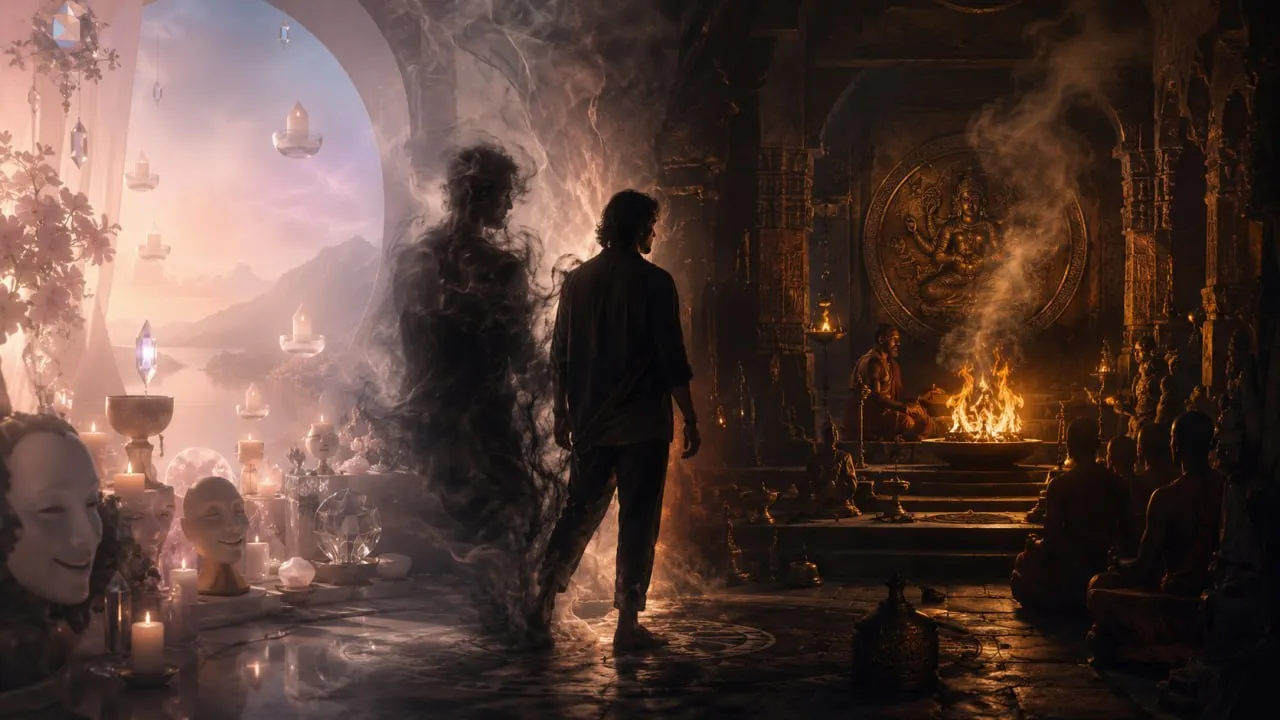
Spirituality has become very accessible today. Everywhere you hear: “Meditations, affirmations, manifestation courses, love & light practices, heart opening, high vibrations, abundance work, women’s circles, kundalini awakening” and so on.
On the surface everything looks beautiful — a person seems to be growing and learning. They try to think positively and repeat: “I choose light”, “I am in love”, “I am in flow”, “I am in nirvana”…
But a month, a year, several years pass — and inside everything is the same. Nothing has fundamentally changed. The question naturally arises: why so many practices, yet no real transformation?
Not every practice leads to transformation
This is important to understand from the start.
Not everything that looks “spiritual” actually changes a person.
Sometimes a practice becomes not a path toward truth, but a way to avoid meeting the truth. A person goes to classes not to see themselves more deeply, but to not feel pain — or simply to pass time in a fashionable way.
Then “spirituality” becomes a beautiful form of avoidance.
Psychology calls this spiritual bypassing. Psychologist John Welwood coined the term to describe using spiritual ideas and practices not for genuine growth, but to bypass unprocessed pain, fear, anger, shame, grief, sexuality, aggression and inner emptiness. The person appears to move upward, yet in reality avoids exactly what they needed to go through.
The “love and light” phenomenon
Today’s continuation of the hippie era is the modern love and light culture. It grows directly from the philosophy of the 1960s, evolving those ideals into contemporary “spiritual practices”. The phrase “love and light” has become a standard greeting and blessing in esoteric, yoga, and spiritual communities — with a very strong shift toward commercialization.
Its language is easy to recognize: “stay in high vibrations”; “don’t drop into negativity”; “just choose love”; “everything happens for a reason”; “you attracted this yourself”; “if it hurts, you’re not in acceptance”.
At first glance this sounds gentle and spiritual. But the problem is that this approach often forbids a person from being “alive” — because a living person is not made only of light. They have diverse emotions, a “shadow”, unfinished stories, unexperienced feelings. If all of this is declared “low vibrational”, the person does not cleanse. They simply begin hiding half of their inner world behind beautiful words.
That is why many modern practices produce no real result
They soothe, decorate, maintain the illusion of growth — but do not always transform.
Why positive thinking can become a trap
Positive thinking is not bad in itself. Gratitude, clear intention, faith, prayer, the ability to find meaning — all of these have power. The problem begins when positivity becomes a prohibition on truth.
When a person says “I am in acceptance” — but inside they are tight with resentment. Or “I am spiritual” — but cannot honestly look at their envy, dependency, pain, fear of loneliness.
That is not spirituality. That is a mask. And the more beautiful the mask, the harder it is to remove.
The shadow cannot be healed with bright phrases
Carl Jung called the shadow those parts of the psyche a person refuses to acknowledge. Not because they are necessarily bad, but because they have been suppressed, rejected, forbidden. Anything can enter the shadow: anger, strength, sexuality, desire, the right to say “no”, the right to want — even life energy itself.
When a person declares everything “dark” to be “unspiritial”, they do not become lighter. They become split. One part smiles, talks of love and tries to be correct. Another part accumulates tension, resentment, aggression, envy, fatigue and inner emptiness.
Then the shadow emerges anyway — through illness, breakdowns, judgement of “less spiritual” people, through the feeling that there are many practices but less and less joy.
The shadow cannot be defeated by a beautiful phrase. It must be seen, cleansed, integrated and transformed.
Why living traditions work more deeply
In genuine spiritual traditions, where wisdom is transmitted from Teacher to student, there was never the naive idea that spirituality is only pleasant, light and soft. Indian tradition has not only Lakshmi, but also Kali. Not only peace, but also the destruction of the old. Blessing and purification. Not only beauty, but also the force that cuts through lies. Tantric traditions worked not with a comfortable self-image, but with the full reality of human nature — because real transformation is impossible when a person works only with the parts of themselves they like.
A living tradition does not say: “Hide your darkness and smile”.
It says: “Look honestly and transform”.
Why practice without a teacher often becomes self-deception
In traditional systems, spiritual practice rarely existed on its own. There was always a Teacher and a transmission. Also discipline, structure and assessment. There was a clear understanding that a person can easily deceive themselves.
Modern spirituality is often structured differently: a person selects their own practice, decides what suits them, interprets their own states, assigns their own path, and confirms their conclusions through people who think the same way.
This is convenient but dangerous. Such practice does not dissolve the ego — it strengthens it. The person begins to see themselves as special, “refined”, “awakened”, “high-vibrational”. But they are no longer working on themselves; they are protecting the image of themselves as a “spiritual person”, gradually sinking deeper into delusion.
This is one of the most dangerous traps.
Why modern practices don’t produce results
Because they work with mood, not with the root. They provide relief, not purification. Inspiration, not discipline. A beautiful state, not an inner turn. New words, not a new life…
A person can attend such practices for years and still remain in the same life pattern.
Real practice does not always bring instant euphoria. It must not only calm — it must change. Change state, choice, relationship to life, the capacity to see truth, and even the line of destiny.
If after a practice a person simply feels calmer for one evening — that is support. But if they begin to live differently — that is transformation.
The essential question
If a modern practice makes a person gentler, more honest, purer, wiser — then it has value. But if it only helps mask pain, avoid truth and maintain a beautiful self-image, then it is not a spiritual path — it is spiritual anesthesia.
The question is not how many practices a person has completed, but whether they have changed — whether they have become purer in intention, closer to the Divine, and not merely to a beautiful image of spirituality.
Perhaps this is exactly why ancient practices are relevant again. Because in a world where spirituality increasingly becomes beautiful packaging, a person does not need a new “self-image” — they need the real Fire of Tradition.
© KailashDham
Ready for a practice?
Yagya, Puja, Tarpana and other Vedic practices — for the key transitions of your life
Learn more