There are things that a person tries not to think about. He can talk about plans, work, money, health, family, and the future.
But there is one topic that the mind often looks away from - Death…
Not because a person knows nothing about it, but because somewhere deep inside he knows too much. He knows: the body is not eternal, and time is not infinite. No day can be lived twice and life cannot be put aside and then started again.
And yet a person often lives as if he has a spare life.
Fear of death rarely speaks directly
Fear of death does not always look like panic. More often he hides in constant haste, in the desire to control everything. In the accumulation of things, cases, statuses, evidence, in the fear of stopping and in the habit of putting off the main thing.
The person says: “Later”… Then I’ll start living, then I’ll take care of myself, then I’ll say important words, and so on.
But this “later” is one of the quietest forms of self-deception. Because life does not begin later - it already goes on. And the question is not “How much time is left?”, but how much a person is present in the time that has already been given.
The stupidity of waiting for death
There is a strange paradox: a person is afraid of death, but at the same time he often turns life into waiting. He is waiting for the right moment, when it becomes easier, when money appears, when the children grow up, waiting for someone to allow him to be himself.
This is how a year goes by. Then another one. And one day you may discover that you didn’t live, but were preparing to live all the time.
This is a real tragedy. Not death itself, but life lived in anticipation of life.
Death is terrible not only because it ends the earthly path. It is also terrible because it shows a person the truth: how much has been put aside, how much has not been said, how much has not been lived, how much of the soul has been spent on someone else’s, empty, not one’s own.
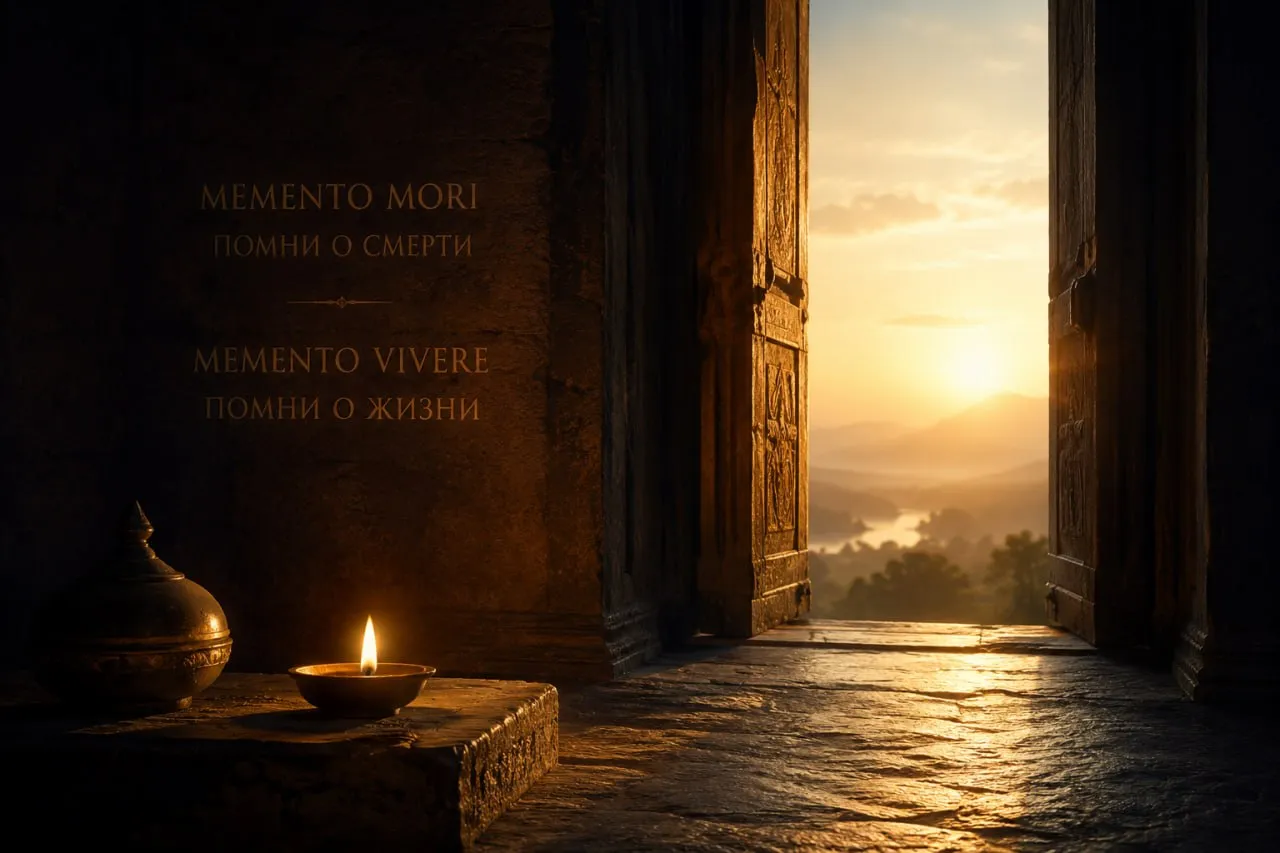
Memento mori: remember death
In the ancient tradition there is an expression: memento mori - “remember death.” Modern people often hear gloominess in this. But in a deep sense, this is not about fear, but about awareness. Remembering death means remembering the value of life. Not in order to live in tension, but in order to stop wasting yourself on small things. This is the ability to enjoy life and its tastes and colors, to live fully and consciously.
Death is a strict teacher. She does not degrade life, she cleanses it of unnecessary things.
When a person remembers that the body is temporary, he begins to hear questions differently:
- why do I live?
- what do I leave behind?
- who do I really love?
- what am I still putting off?
These are not dark questions, but questions of maturity.
Memento vivere: remember life
But next to memento mori stands another contrasting reminder: memento vivere - “remember life.” This phrase focuses attention on life itself and serves as a reminder to appreciate the beauty and joy of life.
Because remembering death without remembering life means going into cold, fear and compression. And remembering life without remembering death means it’s easy to become superficial.
Today the expression “living in the moment” is often understood too poorly. As if living means doing whatever you want. Don’t think about the consequences and don’t take responsibility. Follow every impulse, seek pleasure and run away from difficult questions.
But this is not real presence. It’s just another form of sleep.
Living “in the moment” does not mean forgetting about the future and turning away from the past. This does not mean making desire the main law.
Really living the moment is clarity:
- I’m here;
- I see what is happening;
- I feel life;
- I understand the cost of choice;
- I’m not running away from the truth.
Such a moment does not make a person frivolous, it makes him collected. Because a person who remembers death no longer wants to live automatically. And a person who remembers life no longer wants to live in fear.
Death as a transition
In spiritual traditions, death is not seen as the end of everything: the bodily form ends, but the soul moves on. Death is a transition to another form of existence. Not a punishment or a mistake of the universe, but a boundary between one state of being and another.
A person comes into this world, learns lessons, loves, makes mistakes, purifies himself, grows up, serves, goes through his own path, accumulates soul experience - and one day leaves the body. So it was before us, so it will be after us.
The question is not how to repeal this law. The question is how to live the earthly part of the journey so that the transition is not a meeting with emptiness, regret and internal unpreparedness.
Preparing for death is the art of living well
Preparing for death does not mean living in mourning. This does not mean constantly thinking about the end, giving up joy and fearing every day.
On the contrary: proper preparation for death makes life purer and helps bring order to the body, mind and intentions.
An understanding comes: you can’t endlessly put off the main thing. If love has come, love now; you need to ask for forgiveness - don’t turn pride into a wall: if you need to change the path, don’t wait for life to destroy everything for you: if you pray, pray not only in a crisis; if you need to cleanse your heart, start while it is still able to hear.
Death reminds us: everything temporary will go away, only what has become part of the soul will remain.
Why do we forget to live
We forget to live not because we have little time. We forget to live because we confuse living with being busy. A modern person can be very active and yet deeply absent from his own life. He’s somewhere else all the time. But life happens in the place where a person finally becomes sincere, honest with himself, with those he loves, with his path and with God.
Fear of Death as a Spiritual Signal
The fear of death should not be despised. It can be not only a weakness, but also a signal, showing a person that there is incompleteness inside: meaning has not been found, love has not been lived, important words have not been spoken, real spiritual work has not begun.
If you look at the fear of death honestly, it can become not an enemy, but a door. He asks:
Are you going your own way?
- Do you remember about the soul?
- are you preparing your consciousness for the transition?
- Do you leave behind light or just a trace of fatigue?
These are tough questions. But they bring a person back to the essence.
Spiritual practice as preparation of consciousness
True spiritual practice is needed not only to make a person feel calmer today. It prepares the consciousness for choice, trials, old age and transition.
The mantra clears the mind.
Prayer softens the heart.
Repentance brings back honesty.
Service purifies the ego.
Yagya connects a person with a higher order and helps to bring into the fire that which requires purification and transformation.
A person who practices gradually ceases to be completely overwhelmed by fear.
He may still be sad.
He may still be worried.
He remains a living person.
But another support appears inside - a connection with the Divine. And this is a meaning that does not disappear along with external forms.
© KailashDham
The yagya for this theme
Ready for a practice?
Yagya, Puja, Tarpana and other Vedic practices — for the key transitions of your life
Learn more