Hindu Festivals and Traditions
There is a power a person turns to with the deepest faith and trust — the power of the Mother. She gives life, nourishes, protects, teaches, and helps us rise again after trials. In the Hindu tradition this principle is revered as the Divine Mother — the Great Shakti who creates and sustains the whole universe.
Navaratri is dedicated to Her — one of the most sacred, beloved and colorful festivals of Hinduism, of special significance in the Shakta and Tantric traditions.
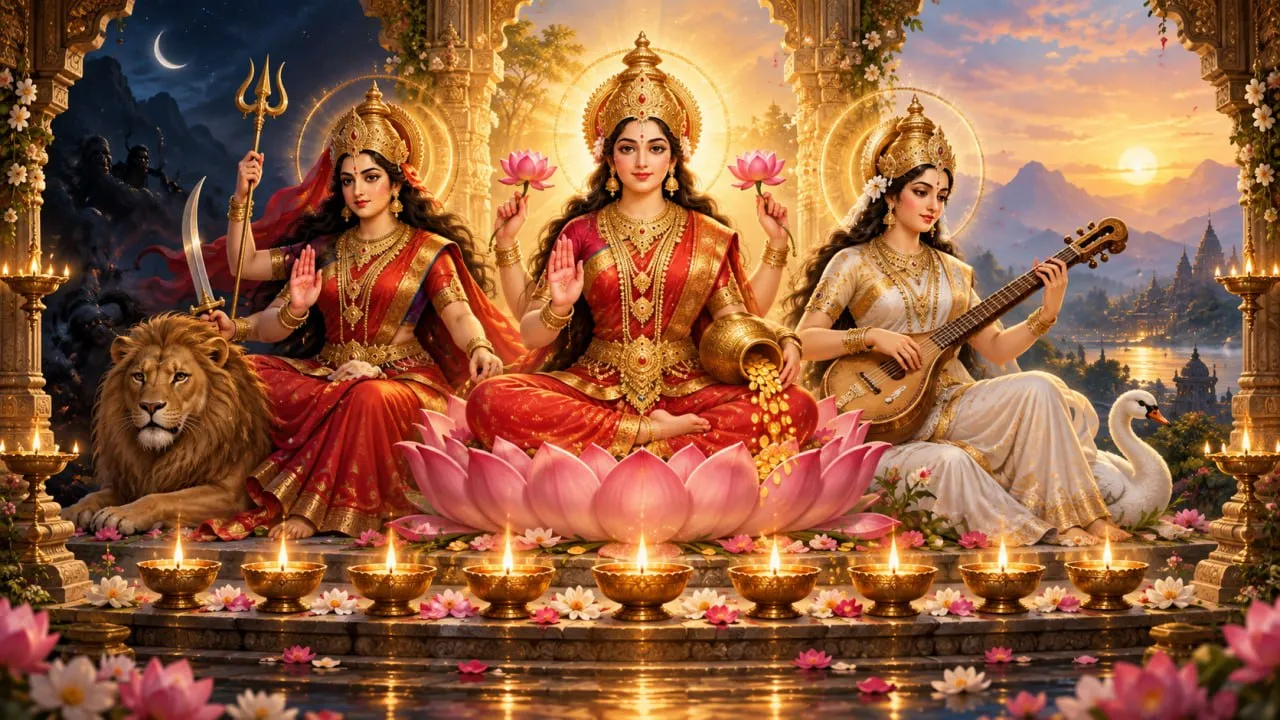
The name “Navaratri” comes from the Sanskrit words “nava” — nine, and “ratri” — night. For nine nights the faithful devote themselves to the worship of Devi — the Divine Mother, who reveals Herself in many forms: Durga, Kali, Parvati, Lakshmi and Saraswati.
During these days pujas are performed, sacred texts are read, mantras are recited, fasts are observed, and prayers are offered for protection, well-being, prosperity, knowledge and spiritual perfection.
The central meaning of Navaratri lies in honoring the one Divine Power that purifies the heart, fills life with virtues and opens the path to wisdom.
The Divine Mother is the Mother of the whole universe, and all living beings are Her children.
When Navaratri Is Celebrated
The two best-known celebrations of Navaratri fall in spring and autumn.
The spring Chaitra Navaratri is observed in the bright half of the lunar month of Chaitra, usually in March or April. The autumn Sharad Navaratri falls in the bright half of the month of Ashvina, usually in September or October.
The autumn Navaratri is celebrated with particular solemnity. It is tied to numerous temple ceremonies, home worship, festive processions and traditions of venerating the Great Goddess. The festival of Durga worship is also known as Durga Puja, or Durgotsav.
Nine nights are devoted to worship, and the tenth day becomes the triumph of the Divine Mother’s victory.
The final days of the festival hold special significance: Mahashtami — the Great Eighth day, Mahanavami — the Great Ninth day, and Vijaya Dashami — the Tenth day of Victory.
The eighth and ninth lunar days have particular importance in the veneration of the Goddess; special rites and prayers are associated with them.
In traditional symbolism the number eight is linked with the balance of the masculine and feminine principles. It is half of sixteen, which in some Tantric teachings embodies the fullness of Shakti’s manifestation and corresponds to the sixteen phases of the moon.
The number nine is tied to Navadurga — the nine manifestations of Goddess Durga. It also recalls the nine months a child spends in the mother’s womb, the ripening of life and the mystery of birth.
In the mystical understanding, the nine nights symbolize a person’s inner path: from the purification of the heart, through the cultivation of virtues, to the unfolding of spiritual wisdom.
The Devi Mahatmya — the Tale of the Divine Mother’s Greatness
At the foundation of Navaratri lies the sacred narrative of the Great Goddess’s battles with demonic forces and Her final victory.
These stories unfold in the Devi Mahatmya — “The Tale of the Goddess’s Greatness,” part of the Markandeya Purana. The text is also known as the Durga Saptashati and the Chandi Path.
The Devi Mahatmya consists of thirteen chapters, grouped into three sections — charitas.
In the first charita the Divine Mother manifests as Maha-Kali, in the second as Maha-Lakshmi, in the third as Maha-Saraswati. These are the three great manifestations of the one supreme Shakti.
In the spiritual interpretations of Navaratri, these forms reveal three fundamental powers:
- Kriya-shakti — the power of action.
- Iccha-shakti — the power of desire and will.
- Jnana-shakti — the power of knowledge and wisdom.
In one traditional system of worship, the first three days of Navaratri are devoted to the purifying power of Durga and Maha-Kali, the next three to the creative power of Maha-Lakshmi, and the last three to the wisdom of Maha-Saraswati.
The Divine Mother is one, though Her power appears in different forms. Each of them reveals a particular side of the spiritual path.
The First Three Nights — Durga. Purifying the Heart
The first three days of Navaratri are dedicated to Goddess Durga, who embodies might, protection and victory over evil.
She appears as the great warrior who defeats demons and restores the Divine order. But Durga’s battle also carries a deep inner meaning.
Anger, greed, hatred, lust, pride and jealousy can take root in the human heart. Gradually these qualities begin to rule a person’s desires, thoughts and deeds. Like invaders, they seize the heart, robbing it of purity and peace.
Worshipping Durga, a person turns to the Divine Mother asking to be freed from the power of destructive passions and to have the obstacles on the spiritual path removed.
Durga’s action can be compared to the art of an experienced surgeon who removes the afflicted part for the healing of the whole organism. In the same way, the purification of consciousness demands the resolve to see one’s own weaknesses and free the heart of them.
Durga grants the strength to overcome what hinders a person’s spiritual growth.
The Next Three Nights — Lakshmi. The Flowering of Virtues
After purification comes the time of creation.
The next three days of Navaratri are devoted to the same Divine Mother in Her gracious manifestation — Goddess Lakshmi.
Lakshmi is depicted on a blossoming lotus, holding lotus flowers in Her hands. The lotus symbolizes purity, beauty, spiritual unfolding and perfection.
Like a flower rising from murky water toward the sunlight, the human soul can reveal its finest qualities even amid life’s trials.
Lakshmi embodies gentleness, harmony, well-being and prosperity. In the traditional understanding, Her favor shows itself in material abundance, spiritual attainment, good fortune, family happiness and the growth of virtues.
But Lakshmi’s wealth also lies in generosity, love, gratitude, nobility and the capacity to care for others.
Where Durga removes the vices, Lakshmi helps the virtues grow. Where Durga performs the symbolic spiritual surgery, Lakshmi brings healing and restoration.
A purified heart becomes fertile ground for creation. Lakshmi nourishes and sustains the soul’s creative expression, helping a person direct their strength toward harmony, well-being and a worthy life.
The Last Three Nights — Saraswati. The Awakening of Wisdom
The last three nights of Navaratri are dedicated to Goddess Saraswati — the embodiment of Divine knowledge, wisdom, sacred speech, art and creativity.
Saraswati reveals to a person what had remained hidden: untapped abilities, spiritual possibilities and the true wealth of the soul.
Her wisdom helps to distinguish the true from the false, the eternal from the fleeting, to see the deep causes of one’s own actions and to be freed from ignorance.
Under Saraswati’s patronage the capacity for knowledge develops, creative gifts unfold, and the understanding of sacred knowledge deepens.
The Goddess leads a person beyond the limits of the ego, opening the possibility of touching the higher dimensions of spiritual being. Her light dispels ignorance and reveals the radiance and majesty of consciousness.
Thus the three periods of Navaratri form a single path: Durga purifies the heart. Lakshmi fills it with virtues. Saraswati illumines consciousness with wisdom.
Vijaya Dashami — the Triumph of the Divine Victory
Navaratri culminates on the tenth day — Vijaya Dashami, the Day of Victory.
It symbolizes the final triumph of the Divine Mother over the demonic forces. One of the festival’s central legends tells of Durga’s victory over the mighty demon Mahishasura.
In the spiritual sense this victory reflects a person’s liberation from the inner demons — anger, greed, pride, ignorance and destructive desires.
The ancient tale reminds us that the deepest battle takes place in the human heart.
In the mystical interpretation, Vijaya Dashami symbolizes the realization of the true Self, when through purification, the cultivation of virtues and the attainment of knowledge a person draws near to the knowledge of their spiritual nature.
Thus nine nights of worship end in the triumph of light, truth and Divine wisdom.
How to Honor the Goddess During Navaratri
In the traditional sadhana of Navaratri, a special place belongs to the reading of sacred texts, the repetition of mantras, the performance of puja and the expression of devotion to the Divine Mother.
Reading the Devi Mahatmya
One of the most important practices is the daily reading of the Devi Mahatmya.
Through the tales of the Goddess’s greatness, Her manifestations and victories over demons, the devotee contemplates the might of Shakti and Her presence in the universe.
When possible, the sacred text is read in full. If that is difficult, individual hymns — stotras from the Devi Mahatmya — may be recited daily.
Focused reading helps direct one’s thoughts to the Divine Mother and strengthen devotion.
Japa of the Navarna Mantra
Of special significance during Navaratri is the repetition of the Navarna mantra — the sacred nine-syllable mantra of Goddess Chamunda.
Om Aim Hrim Klim Chamundayai Vicce
ॐ ऐं ह्रीं क्लीं चामुण्डायै विच्चे ॥
Oṃ Aiṃ Hrīṃ Klīṃ Cāmuṇḍāyai Vicce.
The nine principal syllabic units of the mantra begin with “Aim”; the sacred syllable “Om” is added before them in the common form of recitation.
In the traditional interpretations, the components of the mantra reveal different aspects of the one Shakti.
Aim (Aiṃ) — the bija mantra of Saraswati, connected with speech, mantras, sacred knowledge and wisdom. In the transmitted teacher’s interpretation it also corresponds to rajas — the quality of activity.
Hrim (Hrīṃ) — a sacred bija syllable, associated in this system with Lakshmi, balance, prosperity, well-being and universal beauty. It is related to sattva-guna — the quality of purity, harmony and clarity.
Klim (Klīṃ) — a bija syllable here associated with Kali Ma, the power of time, the dissolution of outlived forms and great change. In this interpretation it corresponds to tamo-guna.
Chamunda (Cāmuṇḍā) — the fierce manifestation of Durga, the victor over the demons Chanda and Munda. In the symbolic explanation Chanda stands for ignorance, Munda for rage and anger. Victory over them means liberation from destructive passions.
Yai (yai) — the ending of the Sanskrit form of Chamunda’s name, expressing the address to the Goddess. In the teacher’s spiritual interpretation it is also connected with the granting of blessing.
Vic (vic) — in the esoteric explanation, linked with the perception of knowledge in the body. Ce (ce) — corresponds to consciousness. Vicce (vicce) — symbolically interpreted as the severing of the demons’ heads, that is, the freeing of consciousness from anger, ignorance and other inner obstacles.
Bija mantras carry layered meanings that unfold differently in different Tantric schools. The explanation given here conveys one line of spiritual interpretation; individual syllables and their correspondences also have other traditional readings.
In the described system of sadhana, it is considered auspicious to begin the japa 30–40 days before Navaratri, three rounds daily. During the festival itself the number of repetitions is increased to nine rounds a day.
Such an order helps establish the discipline of worship and prepare the mind for sustained spiritual practice. For formal Tantric japa, one should follow the guidance of one’s teacher and the requirements of the accepted line of transmission.
Daily Puja
The third important component of Navaratri is puja — the sacred rite of worship of the Divine Mother.
In temples and at home altars the faithful offer the Goddess flowers, incense, a lamp, water, fruit and other traditional gifts.
Everyone can perform a home puja within their means, in keeping with their abilities and spiritual tradition. The essence of worship lies in sincerity of intention, concentration and devotion to Devi.
Family Traditions and Festive Gatherings
Navaratri unites people in prayer and festive joy. In these days it is customary to visit relatives and friends, exchange gifts, congratulate loved ones, and take part in temple ceremonies and shared worship.
Honoring the Divine Mother also shows itself in care for one’s family, respect for elders, kindness, generosity and gratitude for the gift of life.
The Heart of Navaratri — Devotion to the Divine Mother
People turn to the Great Goddess with the most varied prayers.
Durga is asked for protection, strength and the overcoming of obstacles. Lakshmi — for well-being, prosperity, family happiness and material abundance. Saraswati — for knowledge, wisdom, creative inspiration and spiritual insight.
But at the foundation of all these appeals lies bhakti — sincere love and devotion to the Divine. It is devotion that gives prayers, mantras and rituals their deepest spiritual meaning.
Navaratri reminds us that the purification of the heart, the cultivation of virtues and the attainment of wisdom form one single path of spiritual perfection.
The tradition holds that the Divine Mother grants Her devotees mercy, love and protection. Everyone comes to Her with their own hopes and needs; everyone seeks shelter and blessing.
And yet the Mother’s greatest gift is the possibility of drawing near to the Divine — of gaining purity of heart, clarity of consciousness and inner peace.
May the nine sacred nights of Navaratri become a time of sincere prayer, spiritual purification and the awakening of wisdom.
May Durga grant strength and protection, may Lakshmi fill life with harmony and well-being, and may Saraswati bless it with the light of knowledge.
May the grace of the Divine Mother abide in every home, bringing peace, love, prosperity and spiritual joy.
Happy Navaratri! Jai Ma!
The yagya for this theme
Ready for a practice?
Yagya, Puja, Tarpana and other Vedic practices — for the key transitions of your life
Learn more