Hindu Festivals and Traditions
There are nights a person sleeps through. And there is a night one meets with open eyes, because in it begins inner purification and the highest grace arrives. Maha Shivaratri — the Great Night of Shiva — is exactly such a night.
This is a time of fasting, prayer, vigil, worship of Shiva, repetition of mantra and looking inward. Shiva is the image of supreme austerity, inner freedom, the destruction of illusions and grace that liberates. His path is strict, but pure. He removes what is unnecessary so that a person remembers what is essential. He burns pride so that the heart has room for the Divine.
Why This Night Is Called Great
The word ‘Maha Shivaratri’ means ‘Great Night of Shiva’: maha — great, Shiva — the name of the Deity, ratri — night. In Hindu tradition, this festival is dedicated to Lord Shiva and celebrated on the fourteenth lunar day of the dark half of the lunar month. The spiritual core remains one: this is a night of fasting, prayer, vigil, abhisheka of the Shivalingam, and turning toward Mahadeva.
Most festivals a person meets through movement, decoration, socializing and external joy. Maha Shivaratri unfolds through night. This already contains a deep symbol: night removes the excessive brightness of the world, external noise retreats, and familiar roles weaken. A person becomes closer to themselves, their conscience, and those questions that daytime routines often bury.
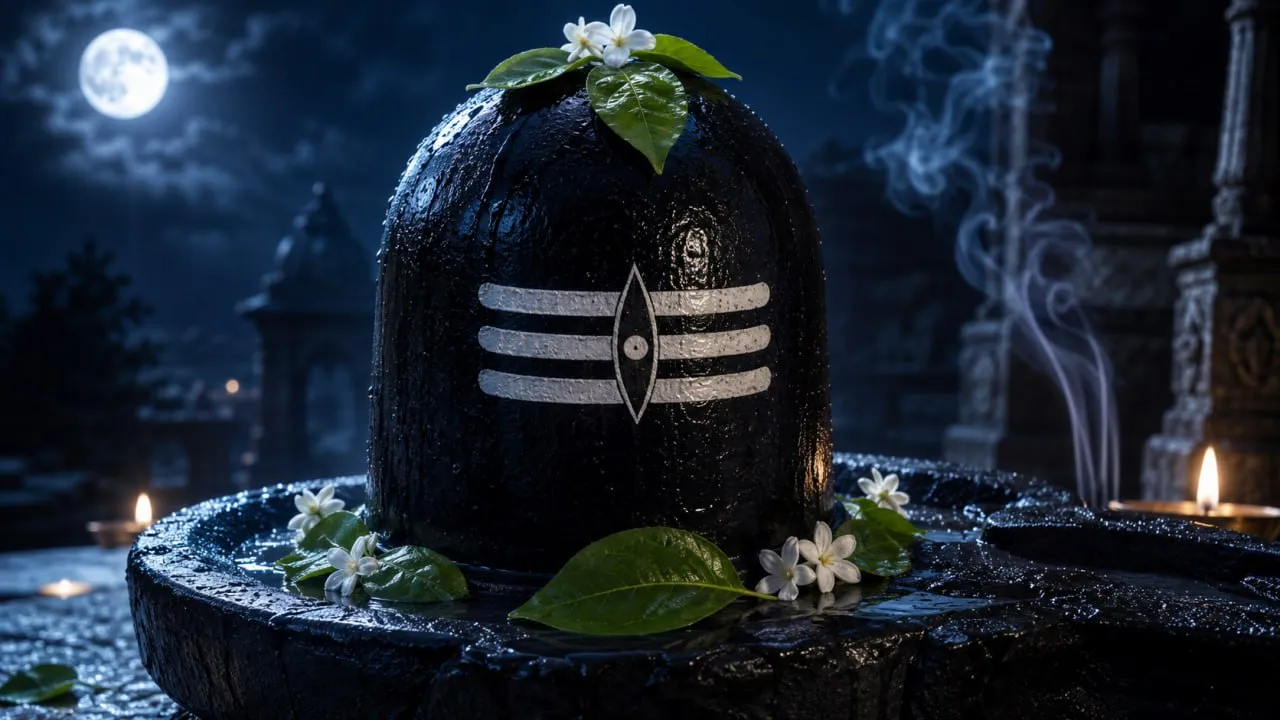
In temples this night, puja is performed, the Shiva-lingam is bathed in abhisheka, mantras are repeated, hymns are chanted, vigils and fasts are kept, offerings of water, milk, honey, ghee, flowers and bilva leaves are made. But the external practice is revealed through inner state. An offering comes alive when a person brings with it their attention, humility and sincere desire to purify the mind.
Shiva as a Force of Purification
Shiva is one of the most profound and paradoxical Divine manifestations in Hindu tradition. He is the ascetic and the husband, the yogi in stillness and Nataraja, the Lord of cosmic dance. He sits in ashes, far from the hustle, and at the same time is connected to the force through which life renews itself.
His destruction has a purifying meaning — Shiva destroys what has become false, heavy and dead within a person: pride, attachment to external image, spiritual overconfidence, hunger for control, the noise of the mind, the habit of living on the surface. He opens the path from inner chaos to simplicity, from hustle to prayer, from the proud ‘I alone’ to the humble ‘lead me’.
Therefore Maha Shivaratri can be understood as a night of inner purification. A person comes to Shiva not only with flowers, water or bilva leaves, but also brings their love, exhaustion, resentment, fear, mistakes, attachments. The Night of Shiva offers a different path: to stop, bow before the Divine and allow what is unnecessary to burn away.
The Shivalingam as Symbol of the Infinite
The central image of worship in Maha Shivaratri is the Shivalingam. In spiritual tradition, the lingam points to the infinite nature of Shiva, to the beginningless and boundless presence of the Divine. Puranic tradition speaks of an infinite pillar of light through which Shiva reveals his eternal nature.
When a person performs abhisheka, pouring water or milk over the Shivalingam, they express an inner prayer: may the mind cool, the heart be purified, pride dissolve, and life turn again toward God.
The Shivalingam teaches something simple: there is a center deeper than thoughts. There is a presence before which the ego naturally bows. There is purification that begins where a person stops arguing with truth.
Shiva and Parvati: Consciousness and the Force of Life
Maha Shivaratri is also associated with the sacred union of Shiva and Parvati. In a deeper sense, this image speaks of the union of consciousness and power, stillness and life, inner height and earthly embodiment. Shiva without Shakti is pure consciousness in stillness. Shakti without Shiva is force seeking a center. Together they express wholeness: silence and action, contemplation and love, austerity and care.
For the modern person this image is especially important. Many live out of balance: much action and little inner center, many desires and little silence. Maha Shivaratri returns one to union: prayer must enter speech, silence must enter decisions, love for God must enter one’s treatment of people.
Fasting, Vigil and Mantra
Fasting during Maha Shivaratri helps the body grow quieter and attention more focused. When a person eats less, speaks less, is distracted less, they begin to see more clearly what fills their mind. The fast becomes a mirror: it shows how much a person depends on habitual comfort and how ready they are to gather themselves for a spiritual purpose.
The vigil this night symbolizes spiritual alertness. A person seems to say: ‘Today I want to remember God. Today I want to be awakened where I usually fall asleep in habit.’
The mantra ‘Om Namah Shivaya’ becomes the heart of this night. It can be repeated quietly, attentively, without hurry. In each repetition there is reverence, purification and a return to oneself. The mantra comes alive when a person pronounces it with attention, humility and readiness to purify their life not only in the temple, but also in words, actions, relationships and life choices.
The Simplicity of Offering
One of the most well-known offerings to Shiva is the bilva leaf. Its three parts are associated with various symbols: the three eyes of Shiva, the three gunas, the three aspects of time. But the main beauty of this offering is its simplicity. Shiva accepts sincerity. His path is connected with austerity, inner truth and a refusal of unnecessary display.
A person can bring costly gifts and remain full of pride. But they can bring water, a leaf, a mantra and a pure intention — and this becomes a true spiritual step. Maha Shivaratri reminds us: God does not need luxury, but a heart ready to become purer.
Maha Shivaratri for the Modern Person
Today a person lives in constant informational noise. They read much, watch much, compare much, tire quickly, often losing connection with body, soul, conscience and prayer. Even spirituality sometimes becomes another external image: beautiful words, powerful phrases, practices without inner change.
The Night of Shiva returns one to a simple question: what within me has ripened for purification? Maha Shivaratri opens the possibility of looking honestly inward and turning to Shiva as the force that helps burn away the unnecessary and preserve what is real.
How to Observe Maha Shivaratri at Home
If it is not possible to visit an ashram or a Shiva temple, one can observe Maha Shivaratri at home. One can create a simple, clean space: place an image of Shiva or a Shivalingam, light a lamp, prepare water for offering, offer flowers, repeat the mantra, sit in silence, dedicate the night to meditation. Shiva accepts sincerity.
Om Namah Shivaya! © KailashDham
The yagya for this theme
Ready for a practice?
Yagya, Puja, Tarpana and other Vedic practices — for the key transitions of your life
Learn more