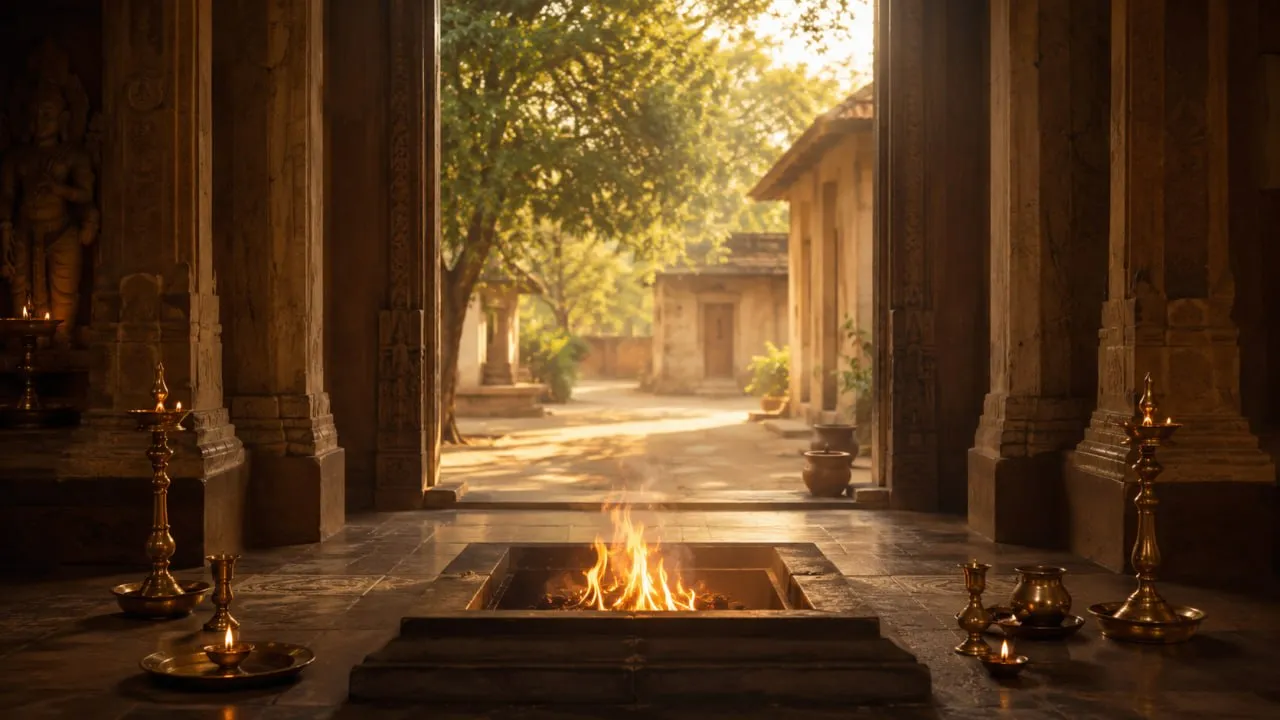
By the fire it is easy to feel the Light.
In life, one can see whether it has become part of a person.
It is easy to be spiritual in the silence of temples. Everything there helps the soul remember what matters most: the fire burns evenly, prayer gathers the mind, breathing slows, the heart fills with love. In such a space it is easier for a person to sense that above the hustle there is Heaven, above fear there is meaning, and above pain there is a path to purification.
The temple gives a person silence.
Life shows what they did with that silence.
After prayer, a person returns home. An ordinary day awaits: conversations, duties, tiredness, money, family, old habits, unresolved questions… And it is precisely there that it becomes clear what actually happened: the person touched a beautiful state — or carried a new clarity out of the practice.
Spiritual practice gains meaning when its light enters speech, actions, and the heart. A person often comes to practice at a moment of inner exhaustion, when an inner overload has long been building. There, various emotions accumulate: fear about the future, weariness of daily life, a sense of loneliness. And the soul begins to look for a place where it can breathe.
Then the person turns to prayer and seeks a Teacher. This is a natural movement, because the mind needs silence, the heart awaits purification, and the body needs rest from inner tension. The soul longs to touch something greater than mundane routine, conflicts, fear, and the constant need to cope…
In the Vedic understanding, human life is connected with dharma — the righteous path that helps one live in harmony with oneself and the world. But dharma does not live only at the altar. It manifests in ordinary life: in the way a person speaks, works, keeps their word, treats those close to them, makes decisions, cares for the body, handles money, and behaves when no one is watching.
Of course, the form of practice also matters: mantra, discipline, and sacred space help a person gather attention and approach a purer state. But form only opens the door — one must walk through it oneself.
Here there is a subtle boundary: practice can open a path to truth for a person, or it can become a beautiful shelter from it. One may seek a special state to feel pain less. Or wait for a sign, even though inwardly the conversation that needs to begin is already clear. One may ask for blessings while continuing to disrupt the order of their own life. And one may speak of God while remaining cold toward the living person nearby.
Such spirituality looks beautiful, but remains fragile. It burns only where it is quiet, and the wind of ordinary life immediately reveals its weak points.
Real practice works differently: it returns a person to ordinary life more sincere and aware, and helps one see the world with clear eyes. And often it is in the simplicity of everyday life that there is more spiritual truth than in beautiful reflections. In difficult times, practice can become a great support, while mature spirituality is free of illusions.
The spiritual path is tested not by words about God, but by how a person lives after those words. Family, home, work, relationships — all of this is the place of real practice. There a person encounters not a beautiful image of themselves, but the truth about themselves. There one can see how much meditation has softened the heart, how much mantra has purified the mind, how much the fire of yagya has become the inner fire of conscience.
Sometimes the most spiritual step is a calm conversation or an acknowledged mistake. A small action done without theatrics, but with a pure intention.
This is how practice enters life.
It is easy to be spiritual in the silence of temples. There the fire, prayer, and beauty help the soul remember the Highest. But a person comes to God not only in a temple — the real inner work begins later.
By the fire, a person remembers the radiance of the Highest.
In ordinary life, they learn to be that Radiance.
© KailashDham
Ready for a practice?
Yagya, Puja, Tarpana and other Vedic practices — for the key transitions of your life
Learn more